ARRIVAL IN COFFEE COUNTRY
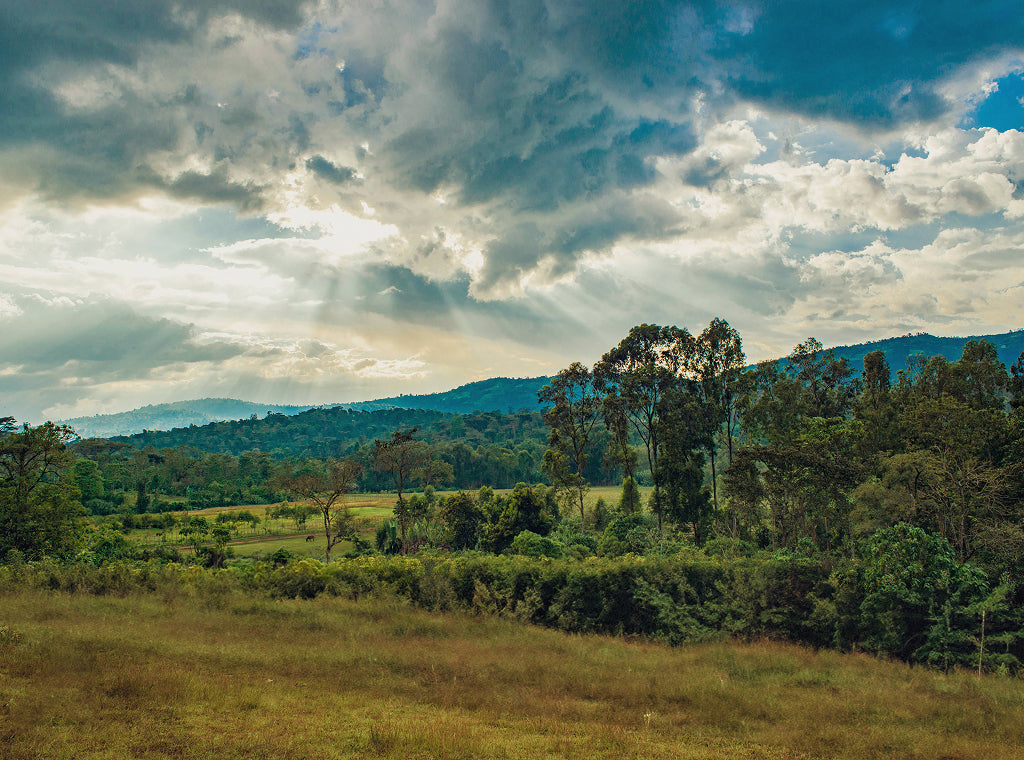
Stepping off the plane in Hawassa, Ethiopia, the first thing you notice is the light—bright, low, and warm in the dry season. Blue mountains stretch across the horizon, and the air carries the faint scent of smoke over fields dotted with shrubs and trees. Waiting for us was Eyoub, a driver with TechnoServe, the nonprofit Peet’s partners with to support coffee farmers across the region. From there, it was a two-hour drive to Dilla along a smooth highway lined with red soil, donkeys hauling water and firewood, and groves of enset, an essential local crop.
Before long, one thing becomes clear: this is a coffee country.
COFFEE, EVERYWHERE YOU LOOK
Through the car window, coffee farms appear everywhere; rows of wiry, aging trees growing beneath the shade of tall avocado and banana trees. It’s a landscape built around coffee, shaped by it, sustained by it. And yet, at first glance, many of these trees are struggling—older, less productive, waiting for renewal.
FROM SPREADSHEET TO SOIL
As Peet’s Responsible Sourcing Manager, I’ve spent the past year immersed in this work from afar—reviewing reports, evaluating grant proposals, and joining calls across time zones from our headquarters in Emeryville, California. I could tell you how many farmers we support. How many trainings we fund. How many trees have been replanted or restored. But until you stand on these farms, it’s all abstract. Because you can’t feel this work through a spreadsheet.
 Minni Forman and Ryan Williams (right) of Peet’s Coffee join Fekele and Aynalem on their farm alongside TechnoServe team, two weeks after stumping their trees. They’re gathered around newly stumped and mulched trees discussing process.
WHAT YOU CAN’T SEE ON PAPER
You can’t smell the dry air or see the strain on aging coffee trees that need renewal. You can’t hear the mix of pride and uncertainty in a farmer’s voice. And you can’t fully understand what it means to cut down a coffee tree—on purpose—until you see it happen.
WHAT IS COFFEE STUMPING?
Stumping is an agricultural technique where farmers cut a mature coffee tree down to about a foot above the ground. It’s a bold move, but a strategic one. With careful management, the tree regrows stronger, healthier, and capable of producing up to three times more coffee. For farmers living on just a few dollars a day, that kind of increase can be transformative.
THE WORK AFTER THE CUT
Stumping may sound simple. It isn’t. After the tree is cut, there’s no harvest for a season. During that time, farmers must invest more labor than ever—mulching, composting, and carefully selecting just a few shoots from the many that emerge. What was once a seasonal rhythm becomes a daily commitment. It’s not just a new technique: it’s a new way of farming.
Feleke and Aynalem one month after stumping. Stumping is a labor-intensive activity, because all of the regrowth needs to be pruned down to only 2 select shoots. The farmer has to remove any other competing shoots every week, and ensure the tree is mulched and has proper nutrients and compost to regrow.
A LEAP OF TRUST
At the heart of stumping is trust. Local agronomy technicians, often from the same communities, guide farmers through the process. They carry the responsibility of encouraging farmers to take a risk, then supporting them every step of the way. For farmers, the decision is deeply personal. A missed harvest. An uncertain future. A promise that requires patience. It’s a leap taken together.
A FARM REIMAGINED
Hirut and her husband, Hailu, made that leap in 2022. When we visited their farm, the results were already visible. Fresh growth covered their trees—small, bright buds signaling a promising harvest in the months ahead. It was a quiet but powerful transformation. Not instant, but unmistakable.
Hirut and Hailu in 2022 before stumping. Trees are wiry, aged, and unproductive.
SCALING IMPACT, ONE FARM AT A TIME
Stories like theirs are not the exception. Over the past seven years, the REgrow Yirga program—implemented by TechnoServe with support from Peet’s Coffee and partners—has trained more than 75,000 farmers and supported the stumping of over 5 million trees across Ethiopia. Healthier trees = stronger yields = more resilient farms. Farmer Hailu and his wife one year after stumping.
LEARNING TOGETHER: THE COFFEE FARMING COLLEGE
In 2025 alone, Peet’s funding helped provide hands-on training and agronomy support to more than 5,000 farmers through the Coffee Farming College. These workshops guide farmers through every step of the stumping journey—from the first cut to long-term farm planning. Because success doesn’t come from a single action. It comes from sustained support.
A CAREFUL BALANCE
We met Feleke just weeks after he began stumping his trees as part of the newest cohort. Alongside his wife, Aynalem, he manages a small farm with about 1,000 coffee trees. This year, they chose to stump 400—balancing risk so they wouldn’t lose all their income at once. With time, training, and regrowth, their income could triple compared to last year.
WHY THIS WORK LASTS
Too often, agricultural projects arrive with energy and funding, only to disappear before lasting change can take root. But REgrow Yirga is different. It’s built on local expertise, long-term commitment, and trust. It works because farmers believe in it, technicians live it, and partners like Peet’s continue to invest in it year after year. Not for quick wins but for lasting transformation.
Hailu and his wife Hirut three years after stumping.
FROM FARM TO CUP
Standing on these farms, it’s hard not to think about the distance between this work and the moment a cup of coffee is poured. What begins here—with risk, labor, and trust—travels across the world to become part of a daily ritual.
WORTH SLOWING DOWN FOR
Behind every cup, there are choices being made—bold ones, like cutting down a tree in the hope of something better. And there are people, like Hirut and Hailu, or Feleke and Aynalem, whose work and optimism make that future possible. It’s a story worth slowing down for.
– Minni Forman, Peet's Responsible Sourcing Manager
A Visit to Ethiopia with REgrow Yirga